CANCER TREATMENT IN INDIA FOR NIGERIAN CANCER PATIENTS
Hundreds of Nigerian Cancer Patients Visit India every month for Cancer Treatments. India has emerged as a global hub for Nigerian Cancer Patients seeking cost-effective, comprehensive Cancer Treatments Abroad. The fame and reputation of Indian Cancer Treating Hospitals are well established, not only among Indians but also attract Cancer Patients from all across the world. Every Year, thousands of Nigerian Cancer Patients Visit India for Comprehensive Cancer Treatments. Cancer patients from many countries visit India for Complete and Comprehensive cancer treatments. The robust, well-managed, and globally recognized healthcare systems in India offer comprehensive cancer treatment for Nigerian Cancer patients.
Cancer Treatment in India for Nigerian Cancer Patients - Table of Contents
|
Cancer Prevalence among the Nigerian Population
Cancer does not discriminate on the grounds of socioeconomic status; rather, it can occur in anyone, whether from a developed country, a developing country, or an underdeveloped country. Cancer can affect people from all walks of life, including men, women, and children. Cancer Cases are rising in Nigeria. As per the reports of the International Agency for Research on Cancer (IARC), in 2024, around 37'400 new cancer cases were diagnosed among Nigerian Men. In comparison, the new cancer cases diagnosed in Nigerian Women were approximately 64'700. There were approximately 30'900 cancer-related deaths among Nigerian men and 40'600 cancer-related deaths among women. The Numbers could have been much higher because of the non-reporting of many Nigerian Cancer Patients.
The Common Cancers among Nigerian Men
The most common Cancers among Nigerian Men are:
Prostate Cancer in Nigerian Men
Prostate cancer is the single largest cancer among men in Nigeria, accounting for approximately 11% of all male Nigerian cancer Patients. The Prostate Cancer rate among Nigerian Men is 41.2 per 100,000, which is significantly higher than the global average of 29.4 per 100,000. Most Prostate Cancer cases in Nigeria are diagnosed at a late, advanced stage, making them incurable and leading to a high mortality rate. This is often due to low awareness, limited screening, and potential underestimation of the true burden of the disease. In 2022, Nigeria accounted for about 17.7% of the new prostate cancer cases and 20.8% of fatalities in Africa.
Colorectal Cancer in Nigerian Men
Once the tenth most common cancer in Nigerian Men, Colorectal Cancer has emerged as the second most common Cancer among Nigerian Men in recent years. The incidence of Colorectal cancer among Nigerian men is higher in Urban areas as compared to rural areas. Young Nigerian Men are more prone to Rectal Cancer.
Liver Cancer among Nigerian Men
Liver Cancer, or Hepatocellular Carcinoma, is also diagnosed in Nigerian Men. The Main identified reason for Liver Cancer among Nigerian Men is infection with Hepatitis B. Hepatitis C also contributes to Liver Cancer among Nigerian Men, although in a much smaller number. Liver Cancers are diagnosed in Younger Nigerian Men. The incidence of Liver cancer in Nigerian Men is much higher than in Nigerian Women.
Non-Hodgkin Lymphoma in Nigerian Men
Non-Hodgkin's Lymphoma is also a common Cancer among Nigerian Men. Nigerian Men are more prone to Non-Hodgkin's Lymphoma as compared to women. The most common subtype in adults is diffuse large B-cell lymphoma (DLBCL), while Burkitt's lymphoma (BL) is most prevalent in children and adolescents. The Epstein-Barr virus (EBV) and HIV have been associated with certain subtypes of lymphoma in Nigeria.
Non-Melanoma Skin Cancer in Nigerian Men
Non-melanoma skin Cancer is also significantly high among Nigerian Cancer Patients. The most common type of Non-Melanoma Skin Cancer among Nigerian Men is Squamous Cell Carcinoma. Old trauma, chronic ulcers, old scars, and inflammation are major risk factors for Squamous Cell Carcinoma in Nigerian Men.
Bladder Cancer in Nigerian Men
Bladder Cancer accounts for a significant number among Nigerian Men suffering from Cancer. In fact, the enormity of the prevalence of Bladder Cancer among Nigerian men can be gauged from the fact that it is observed as the second most common cancer in Nigerian men after prostate cancer. High rates of urinary schistosomiasis, caused by the Schistosoma haematobium parasite, as well as other chronic irritants like bladder stones, contribute significantly to Bladder Cancer in Nigerian Men.
Stomach Cancer in Nigerian Men
Stomach Cancer is another common Cancer affecting Nigerian Men. The identified factors for Stomach cancer in Nigerian Men are Helicobacter pylori infection, smoking, high-salt and preserved food consumption, and a family history of cancer. Adenocarcinoma is the major subtype of Stomach Cancer affecting Nigerian Men.
Common Cancers Affecting Nigerian Women
The most Common Cancers affecting Nigerian Women are:
Breast Cancer in Nigerian Women
Breast Cancer is the number one cancer among Nigerian Women, accounting for over 22% of all new cancer cases. In 2020, 28,380 new breast cancer cases were diagnosed among Nigerian Women. Breast Cancer is the leading cause of cancer-related death among Nigerian Women. There is a high prevalence of aggressive subtypes of breast cancer, the triple-negative Breast Cancer, in Nigerian Women.
Cervical Cancer Among Nigerian Women
Cervical Cancer is the second most common Cancer Among Nigerian women. Around 12,000 new Cervical Cancer cases are diagnosed annually among Nigerian Women, and around 8,000 women die in Nigeria from Cervical Cancer. Infection with Human Papillomavirus is the major factor responsible for Cervical Cancer in Nigerian Women.
Ovarian Cancer in Nigerian Women
Ovarian Cancer is another common cancer among Nigerian Women. The identified risk factors for Ovarian Cancer among Nigerian Women are a family history of cancer, early menarche, and nulliparity.
Colorectal Cancer in Nigerian Women
Colorectal cases in Nigerian women are rising, and it is ranked the third most common cancer affecting Nigerian Women after Breast Cancer and Cervical Cancer. Most colorectal cancers affect younger Nigerian Women.
Soft Tissue Cancer in Nigerian Women
Soft tissue cancers also affect Nigerian Women, although the occurrence is not very common. Soft Tissue Cancers affect younger Nigerian Women. Fibrosarcoma and Kaposi sarcoma are the common types of Soft Tissue Cancers in Nigerian Women.
Thyroid Cancer in Nigerian Women
Thyroid Cancer affects middle-aged Nigerian Women. Papillary Thyroid Cancer is more common, but Follicular Thyroid Cancer, Medullary Thyroid Cancer, and Anaplastic Thyroid Cancer also affect Nigerian Women.
Non-Melanoma Skin Cancer in Nigerian Women
Nigerian Women are also affected by Non-Melanoma Skin Cancer. Squamous Cell Carcinoma is the main type of Non-Melanoma Skin Cancer in Nigerian women. The Known risk factors of Non-Melanoma Skin Cancer in Nigerian Women include albinism and trauma, and the head and neck region is the most frequent site for NMSC.
Common Cancers in Nigerian Children
The Most Common Cancers reported in Nigerian Children are Lymphomas and Leukemias. Nigerian Children up to the age of four years are affected more by Neuroblastoma and Nephroblastoma. Older Nigerian Children are affected with Lymphoma, retinoblastoma, Soft Tissue Cancers, Bone Cancers (Osteosarcoma), and renal tumors (Wilm's Tumor and Nephroblastoma).
The Reason for Nigerian Cancer Patients Seeking Cancer Treatments Abroad
The Healthcare system in Nigeria needs significant improvement, particularly in cancer treatments. Due to underfunded health sectors and a scarcity of proper cancer care facilities, the Lack of adequate diagnostic facilities and qualified Cancer treatment specialists, Nigerian cancer patients prefer cancer treatments outside Nigeria. Nigerian Cancer Patients often have to travel long distances to reach the nearest cancer center, which can delay diagnosis and treatment. The diagnostic facilities for cancer detection in Nigeria are restricted to the capital city, Abuja, and to a limited number of major cities.
The three major cancer treatment specialties- Cancer Surgery (Onco-Surgeons), Radiation Therapy (radiation oncologists), and chemotherapy (medical oncologists)- are also inadequate due to the scarcity of equipment, medicines, and qualified specialists. This has led to Nigerian Cancer patients seeking cancer treatment abroad if they can afford it.
Why Nigerian Cancer Patients Prefer Cancer Treatment in India
Thousands of Nigerian Cancer Patients visit India every year for comprehensive Cancer Treatment. Nigerian Cancer Patients prefer Cancer Treatment in India due to the following factors:
- No Waiting Period for Nigerian Cancer Patients for Commencement of Cancer Treatment in India.
- Precise Cancer Diagnosis and Better Treatment Outcomes in Major Cancer Treatment Hospitals in India.
- Indian Cancer Hospitals offer Reasonable Cost of Cancer Diagnosis and Cancer Treatment in India for Nigerian Patients.
- Accurate and Precise "Genome Profiling" for determining the best-suited Targeted Drug and Immunotherapy for Nigerian Cancer Patients.
- Indian Cancer Hospitals offer cutting-edge imaging like FDG PET/CT, PSMA PET/CT, and DOTA PET/CT for accurate Cancer Diagnosis in Nigerian Cancer Patients.
- Indian Cancer Hospitals provide Organ-Sparing Cancer Surgeries assisted by expert Plastic Reconstruction Surgeons for Nigerian Cancer Patients.
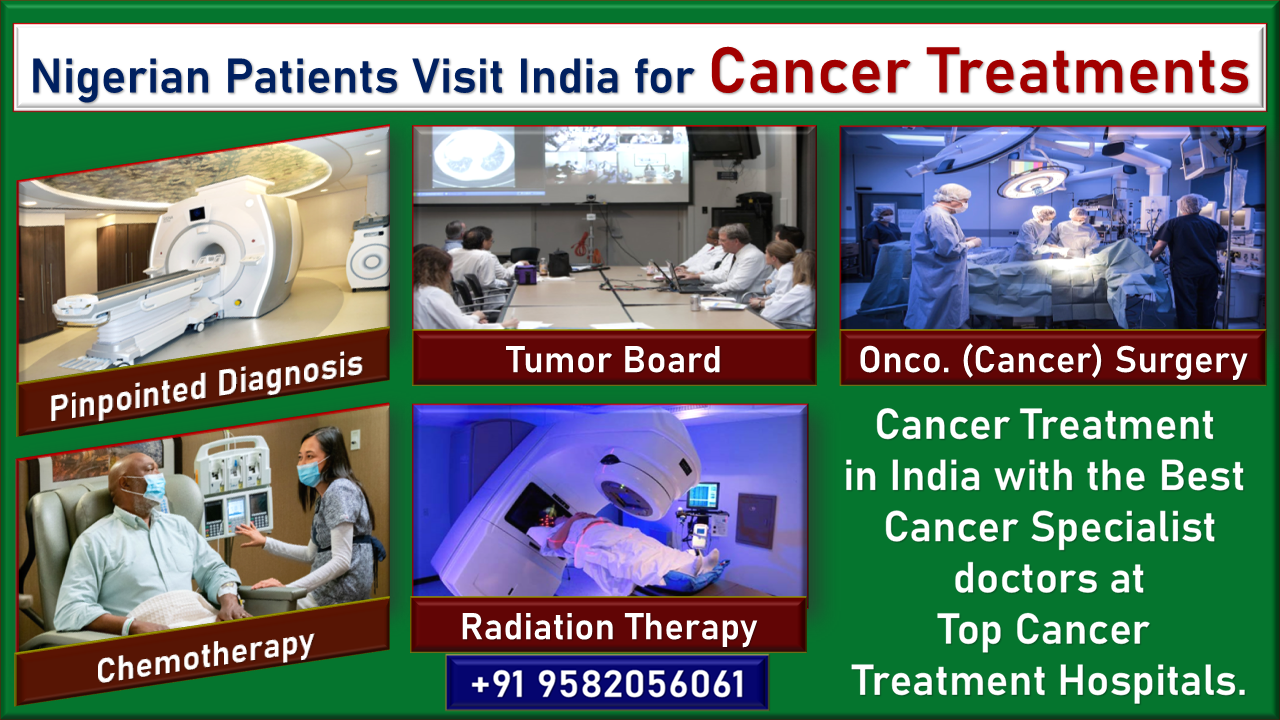
- Regular Tumor Board for every Individual Nigerian Cancer Patient by the Multidisciplinary Cancer Specialists
- Latest Radiation Therapy Techniques and Technologies for Nigerian Cancer Patients
- All the Multidisciplinary cancer Specialists under the same roof and collaborating for better cancer treatment outcomes for Nigerian Cancer Patients.
- Comparatively Lower Cancer Treatment Cost in India for Nigerian Cancer Patients.
- The best and most Experienced Cancer Treatment Specialists provide comprehensive Cancer Treatment for Nigerian Cancer Patients.
- Lower Logistics Costs for Nigerian Cancer Patients for an Indian Stay for Cancer Treatment in India.
- As most Nigerians are fluent in the English Language, there is no Language Barrier in Nigerian Cancer Patients' Cancer Treatment in India.
- Patient Care Experts of CMCS Health keep track of Regular Treatment Follow-up to avoid cancer recurrence in Nigerian Cancer Patients.
Nigerian Prostate Cancer Patients prefer Prostate Cancer Treatment in India.
The Success of Prostate Cancer Treatment depends on the accurate Grading of the Cancer. The Top Cancer Treatment Hospitals in India use the Gleason score and grade group to determine the best Prostate Cancer Treatment protocol for every Nigerian Prostate Cancer Patient.
Surgery is the Gold Standard for any Cancerous growth. Top Indian Cancer Treatment Hospitals offer Prostatectomy or Prostate Cancer Surgery for the removal of the prostate. CMCS Health has partnered with The Best Indian Prostate Cancer Surgeons, who routinely perform Da Vinci Robotic Prostatectomy or minimally Invasive Laparoscopic Prostate Cancer Surgery for early recovery and the least risk of erectile dysfunction for Nigerian Prostate Cancer Patients.
The Best Cancer Treatment Hospitals in India offer the services of the Most Experienced Radiation Oncology Doctors. CMCS Health is affiliated with The Best Indian Radiation Oncologists, who perform both External Beam Radiation Therapy (EBRT) and Brachytherapy (internal seeds) to kill cancer cells for Comprehensive Prostate Cancer Treatment in India for Nigerian Prostate Cancer Patients.
The Best Medical Oncologists in India provide Chemotherapy for fast-growing cancer cells, typically for advanced or hormone-resistant cancer.
Nigerian Prostate Cancer Patients also prefer India for Prostate Cancer Treatments, as Indian Medical Oncologists also provide the latest Targeted drug Therapy & Immunotherapy for specific genetic mutations or to boost the immune system for Nigerian Prostate Cancer Patients. CMCS Health, the Best Medical Tourism Company in Nigeria, has assisted Scores of Nigerian Prostate Cancer Patients with Successful Prostate Cancer Treatment in India.
India is the Number one Destination for Breast Cancer Treatment among Nigerian Women.
Nigerian breast cancer patients prefer India for an accurate Breast Cancer Diagnosis, about the stage and type of Breast Cancer, and subsequent Breast Cancer Treatment. The Reasons for Nigerian Breast cancer Patients choosing India over other Medical tourism destinations are due to Breast cancer-specific specialized oncology departments offering advanced Breast Cancer therapies like advanced Nipple nipple-sparing breast Cancer Surgery, breast reconstruction oncology surgery, advanced and more effective chemotherapy regimens for Breast Cancer Treatments, Proton Radiation therapy, and the latest targeted drugs like Herceptin for HER2-positive Breast Cancer Patients, at comparatively affordable costs.
The Best Medical Tourism Company in Nigeria, CMCS Health, provides professional assistance for logistics (visa, stay, airport transfers) and ensures personalized care for Nigerian Breast Cancer Patients. Our team of Patient Care experts provides post-treatment follow-ups for every Nigerian Breast Cancer patient.
Gynecological Cancer Treatment in India for Nigerian Women
CMCS Health, the Leading Medical Tourism Company in Nigeria, assists Nigerian Women with successful gynecological cancer treatments in India. Gynecological Cancers start in a woman in the reproductive organs, like the Cervix, Ovaries, Uterus, Fallopian Tubes, Vulva, and Vagina. The most common of all Gynecological Cancers in Nigerian Women is Cancer of the Cervix. The Best Cancer Treatment Hospitals in India for Nigerian Cancer Patients offer the latest treatment modalities for Gynecological Cancers in Nigerian Women.
Latest Therapies in India for Advanced Cervical Cancer Treatment in Nigerian Cervical Cancer Patients
The top Medical oncologists in India are well-versed in administering the latest and most advanced immunotherapies like Pembrolizumab, Atezolizumab, and the newest Targeted drug therapies like the Antibody-Drug Conjugates / ADCs such as tisotumab vedotin, for advanced cases of CA-Cervix. These latest immunotherapies and Targeted Drug therapies have shown better cervical cancer treatment outcomes in Nigerian women by harnessing the immune system and targeting specific cancer pathways. CMCS Health, the trusted Medical Tourism Agency by Nigerian Patients, has assisted scores of Nigerian CA-Cervix patients with their Cervical Cancer Treatment in India.
Latest Ovarian Cancer Treatments in India for Nigerian Ovarian Cancer Patients
The Leading Medical Tourism Company in Nigeria for Nigerian Cancer Patients' Cancer Treatment in India has partnered with the Top Cancer Treatment Hospitals in India for Cost-Effective Comprehensive Cancer Diagnosis and subsequent Medical Treatment in India. They are one of the very few Medical Tourism Companies that have a Medical background and ask all the relevant questions to the Best Indian Ovarian Cancer Specialists for giving a complete Ovarian Cancer Treatment Plan for Nigerian Ovarian Cancer Patients. The Best Ovarian Cancer Specialists treat Nigerian Ovarian Cancer Patients with the newest Targeted Drug Therapies.
Most Cost-Effective CAR-T Cell Therapy in India for Nigerian Leukemia Patients: